Engineering Reliable Biogas Storage: How Ecomembrane Supports Smarter Renewable Energy Projects

By Ecomembrane
As biogas and biomethane infrastructure continues to expand across Europe and North America, project developers, municipalities and engineering firms are facing increasing pressure to deliver facilities that are not only efficient, but also resilient, scalable and future-ready. In this evolving landscape, gas storage systems have become much more than a secondary plant component; they are key contributors to operational stability, process efficiency, and long-term project performance.
At Ecomembrane, we have spent more than 20 years designing and manufacturing membrane-based solutions that help operators manage biogas safely and efficiently across a wide range of applications. Since our founding in 2000, our mission has remained consistent: to engineer reliable storage solutions that combine durability, performance and practical usability for real-world plant operations.
Today, with more than 1,300 installations worldwide and manufacturing facilities in both Europe and the United States, we continue to support renewable energy projects in agricultural, industrial, and municipal sectors. Our experience across different climates, plant configurations and operational requirements has allowed us to develop a flexible approach tailored to the realities of modern biogas infrastructure.
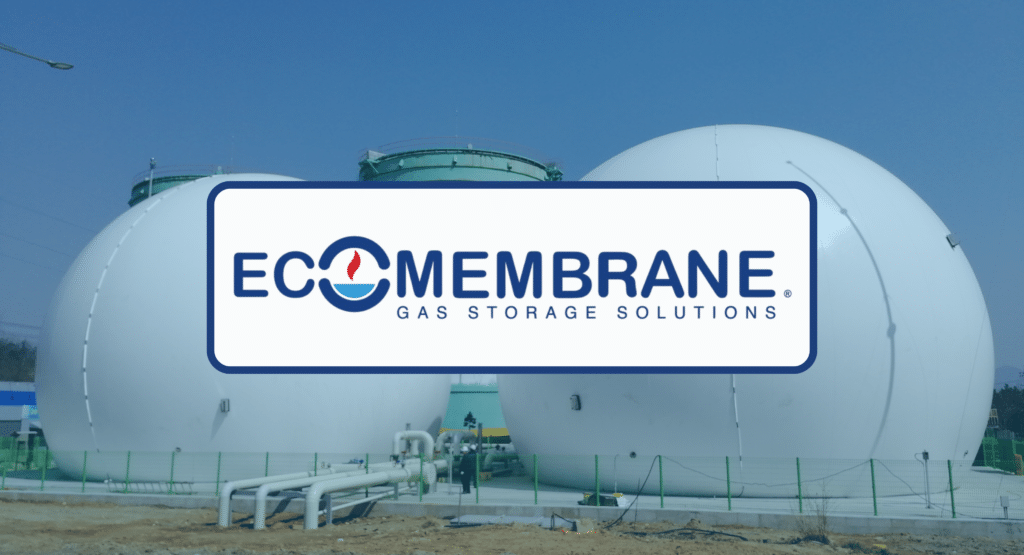
At the core of our portfolio are our double- and triple-membrane gasholders for digesters and tanks. Designed to collect and accumulate biogas while minimizing thermal dispersion, these systems play an important role in maintaining stable digester conditions and optimizing plant efficiency. For engineering firms and developers, this means integrating storage systems that contribute not only to gas containment but also to overall process performance.
Every project presents unique operational challenges. Some facilities prioritize maximizing gas capacity, while others focus on simplifying maintenance, reducing heat loss or improving long-term reliability. Our membrane systems are designed with this flexibility in mind, offering customizable configurations capable of adapting to different plant sizes and technical requirements.
In parallel, odour management and environmental compliance have become increasingly important considerations for municipalities and industrial operators alike. To address these needs, Ecomembrane developed the M1 Cover, a versatile single-membrane solution designed for pre-tanks and post-digestion tanks. Depending on project requirements, the M1 Cover can function as an odour-control and rainfall-protection cover or as a gas-tight storage solution.
For facilities operating in urban areas or regions with stricter environmental regulations, this type of integrated approach can help simplify compliance while improving operational reliability. By combining protection, containment and durability within a single solution, projects can reduce complexity without compromising performance.
Innovation also remains central to our long-term vision. While biogas and biomethane continue to represent key sectors for Ecomembrane, we are also investing in technologies designed to support the future of renewable gas infrastructure, including hydrogen and CO₂ storage applications. As energy systems evolve, we believe suppliers must evolve alongside them; not only by improving existing technologies, but by preparing for emerging market needs.
This commitment to continuous improvement is reflected in several of our recent developments, including advanced membrane configurations, modular anchorage systems and specialized storage technologies designed to improve efficiency, simplify installation and enhance long-term operational performance.
Our work is ultimately defined by the projects we support. Across the world, Ecomembrane systems are operating in agricultural digesters, industrial facilities, and wastewater treatment plants where reliability is essential. Projects such as the React Yonezawa installation demonstrate the importance of combining high-performance gas storage with efficient installation management, while the Ariano Biometano Plant highlights how reliable storage systems can support automation, operational continuity and stable gas quality.
Beyond the technical aspects, successful infrastructure projects also depend on collaboration. Over the years, we have worked closely with developers, EPC firms, municipalities and operators to adapt solutions to specific project conditions and long-term operational goals. This collaborative approach allows us to contribute not only as a technology supplier but as a technical partner throughout the lifecycle of a project.
As the renewable energy sector continues to scale, the expectations placed on biogas infrastructure will only increase. Facilities must operate efficiently, comply with evolving environmental standards and remain economically sustainable over the long term. In this context, membrane systems are no longer simply supporting components; they are strategic assets that directly influence plant reliability and performance.
At Ecomembrane, we believe that effective gas storage starts with practical engineering, proven materials and a deep understanding of how biogas facilities operate every day. Whether supporting a municipal wastewater project, a large-scale agricultural digester or a biomethane upgrading facility, our objective remains the same: delivering membrane solutions designed to help renewable energy projects perform safely, efficiently and reliably for years to come.
You can find more news like this in the Biogas Community Magazine – Europe Edition 2026.

Comments