Roadmap to High-Fat Digester Operations

By Trisha Aldovino, Process Analyst and David Ellis, Principal Engineer from Azura Associates @AzuraAssociates.Deidre

John runs a good anaerobic digester. He’s fought through clogged pumps, surprise foam, and the kind of biology-driven chaos that only operators understand! Now he wants more biogas, and he’s eyeing fatty wastes like DAF (dissolved air flotation), FOG (Fat, Oil, and Grease), and rendering streams because fat can be a performance booster. High-fat digestion operation is simple, but it isn’t easy. Are you in the same spot as John? Think of training like an athlete and follow these three steps to reach your digester’s high-fat operational goals:
Step 1: Check your baseline. Start with a checkup. For digesters, that means characterizing the feedstocks that make up most of your annual volume (what’s really in the “diet”?) and checking digestate health to catch hidden deficiencies or risks. Before you feed more fat, use two simple go/no-go checks: (1) HRT (Hydraulic Retention Time) > ~18 days, and (2) fat < ~20% of weekly VS (volatile solids) in the blended feed. If you pass both, you likely have safe headroom to increase fat.
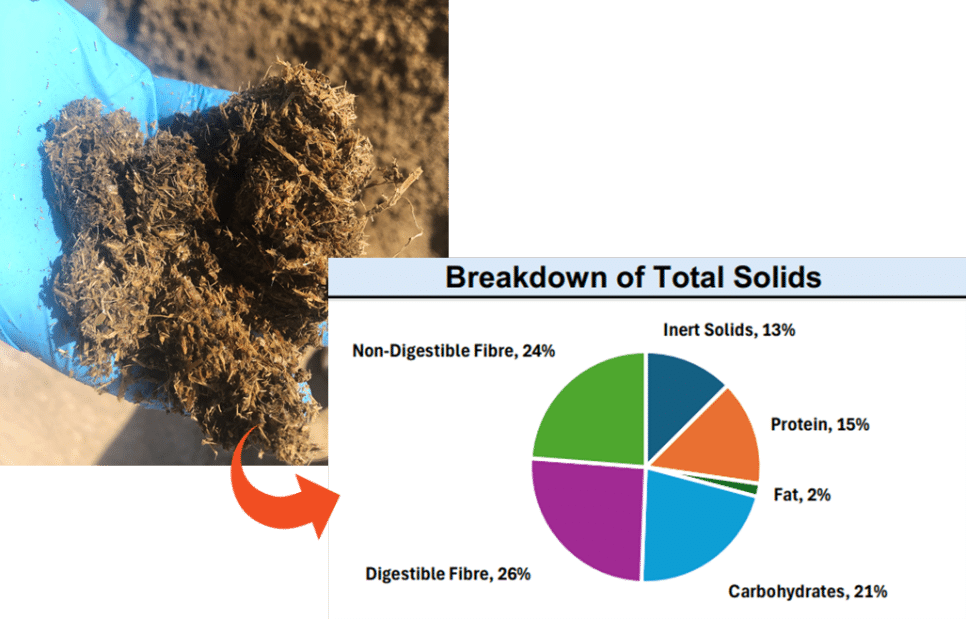
Step 2: Prepare like a champion. Clean up the digester’s diet by minimizing low-fuel, low-value inputs (too much water, inert solids, or hard-to-digest fibre). Then make sure the biology has what it needs. High-fat systems are more likely to need micronutrients (e.g., cobalt & selenium, etc.) than manure digesters. Most importantly, don’t increase the feed when the system is already strained. Pause and stabilize if you see: VFAs (Volatile Fatty Acids) > 4,000 mg/L, rising LCFAs (Long Chain Fatty Acids), foam, or dropping pH < 6.8 (or drifting above 7.6). Recovery to a steady baseline often takes 2–4 weeks—and it’s cheaper than starting over with new seed.
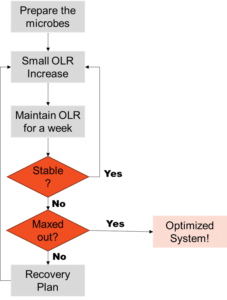 Step 3: Ramp with discipline. The safest high-fat ramp looks like progressive overload: increase OLR (Organic Loading Rate) by ~10%, then hold for at least a week while the microbes adapt. Only increase again once gas production and stability indicators have settled into a new normal. If you overshoot, treat it like an injury: minor upsets (small VFA spikes) often resolve by holding steady; major upsets (large VFA/LCFA spikes, rapid pH drop, persistent foam) may require reducing or stopping feed, adding alkalinity, and executing a recovery plan.
Know when you’ve hit your current ceiling. If instability keeps returning, you may be maxed out. Two telltale signs: (1) your overall HRT is already ~18 days (it’s possible to digest fats at a shorter HRT, but that’s Olympic-level performance), and (2) even small OLR bumps reliably trigger VFAs/LCFAs, foam, or pH slide (biology is the limiter).
Ready to add fat in your digester? Email Azura at learn@azuraassociates.com. Send your weekly feed volumes, %TS Total Solids /%VS Volatile Solids (or recent lab results), and digester working volume, and we’ll help you confirm your HRT and fat-%VS headroom and map a conservative high-fat ramp plan tailored to your site.
Find more insights like this in the Biogas Community Magazine – Europe Edition 2026





Comments