Sunnyvale’s Organics Operations Upgrade: A Year of Progress Toward 90% Organic Recovery

By Van Dyk Recycling Solutions
A full-scale depackaging system replacement has boosted recovery, efficiency, and capacity.
In the summer of 2024, the City of Sunnyvale, CA, completed a major overhaul of its food waste depackaging system to comply with California’s SB1383 mandate to divert organic waste from landfills. Now, more than a year later, the impact of that investment is becoming clear: higher recovery rates, increased processing capacity, and streamlined operations that continue to support the city’s organics diversion goals.
Funded through the CalRecycle Organics Grant Program, Cycle 5, the project increased storage capacity by 60%, improved truck unloading times, and pushed organics recovery to nearly 90%.
The facility accepts both commercial source-separated organics (SSO)– including food waste from restaurants and other businesses—as well as residential SSO collected curbside.
Since the upgrade, the system has been running steadily at 18–20 tph or more (up from 15 tph before the project) while maintaining organic recovery rates above 85%. The resulting slurry is sent to wastewater treatment facilities for further processing.
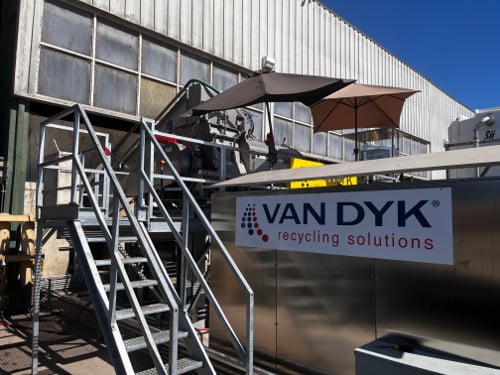
The equipment, supplied by Van Dyk Recycling Solutions of Norwalk, CT, included a 10–12 ton storage and feed bunker, a walking floor for added storage and quality control, the SMIMO120 depackager as the primary separator, a SMIMO15 grinder for final slurry refinement, and a series of pumps and conveyors that keep material moving efficiently between units.
A key operational improvement came from the in-ground feed bunker, which allows hauling trucks to unload directly, cutting average unloading times to around five minutes.
Three shaft-less screws in the bunker pre-mix material before feeding it into the SMIMO120 depackager, reducing the risk of wrapping contamination and ensuring smoother processing.
Material is then conveyed across a walking floor for visual inspection, where bulky contaminants can be easily removed before depackaging.
Inside the SMIMO120, a 360-degree rotating steel drum separates organics from packaging to create a high-quality slurry. An integrated dewatering pump recycles liquid from the bunker, eliminating the need for an external water source. Packaging is conveyed away with residue, while the slurry continues on to the SMIMO15 grinder, which reduces particle size to under ½ inch and removes grit and glass before it is sent to wastewater treatment.
Mid-system tanks and pumps maintain steady throughput, preventing bottlenecks and ensuring a consistent flow across all processing stages.
Looking back, Sunnyvale’s investment in its depackaging system has proven to be more than just an equipment replacement.
It has helped the city meet state requirements, improve efficiency across its organics program, and move closer to its long-term sustainability and landfill diversion goals.
For more information, read our Efficiency Magazine.

Comments